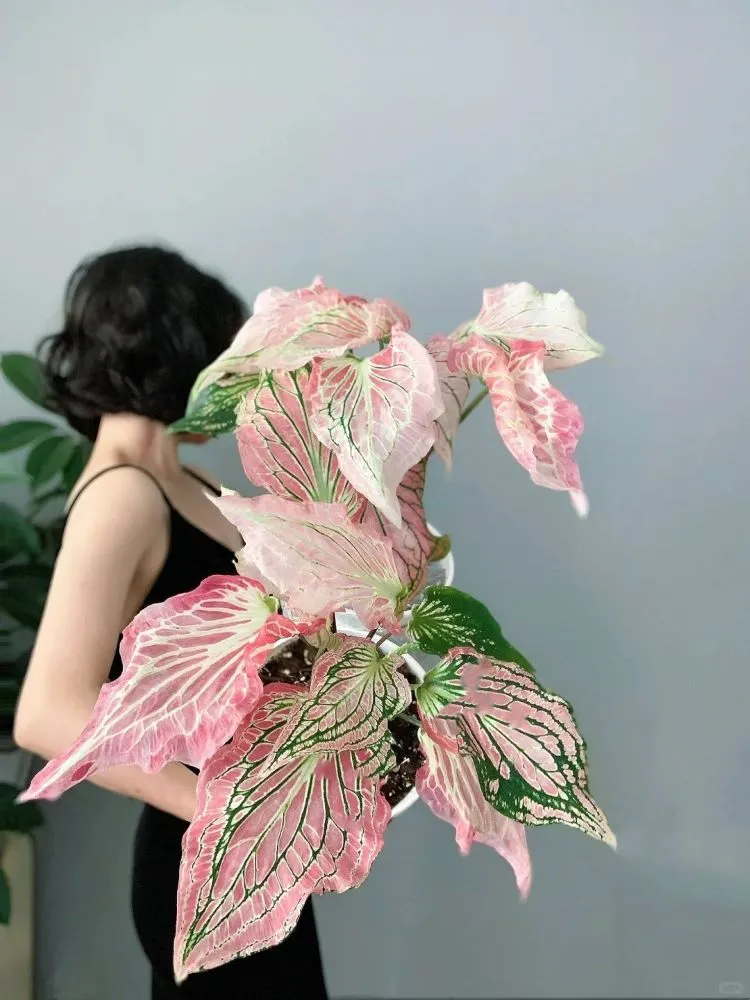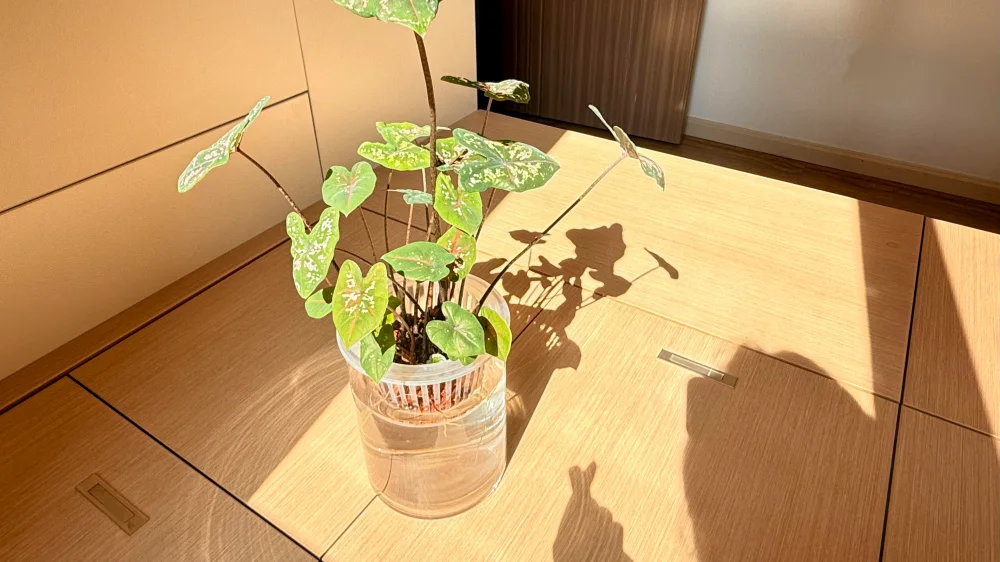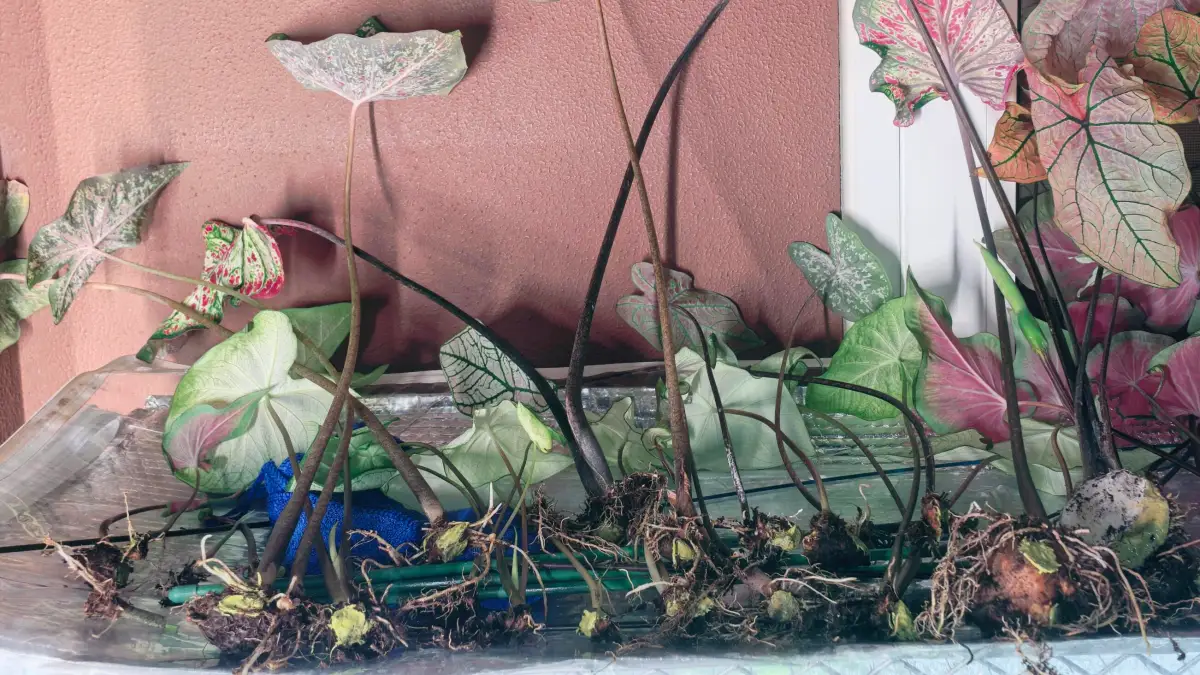
Miss Muffet is often described as a lime-green caladium with burgundy speckles — compact, bright, and visually distinct from pink-centered varieties.
However, after growing this cultivar for three consecutive seasons in different balcony conditions, I found that its appearance is far less stable than most descriptions suggest.
Over three years, I observed:
- Significant color shifts depending on light intensity
- Rapid greening under high summer heat
- Inconsistent vein contrast between seasons
- Strong vegetative growth that did not always correlate with color quality
I also learned not to treat every color shift as a watering problem — Miss Muffet can look “off” even when moisture is perfectly fine.
In low light, the plant lost contrast and became predominantly green.
Under strong light, leaf size increased — but color stability still fluctuated.
In hotter periods, even mature leaves reverted to deep green.
These patterns repeated across multiple growth cycles, which suggests that environmental factors alone do not fully explain its behavior. Genetic expression likely plays a larger role than commonly acknowledged.
This article documents how Miss Muffet performed in my north-facing balcony (low light phase) and later in a south-facing balcony (high light phase), including repotting changes and fertilizer adjustments.
If you are considering growing Miss Muffet, especially in warm climates, understanding its environmental sensitivity and potential genetic variability is more important than relying on promotional photos.
What follows is not a catalog description, but a three-year cultivation record focused on:
- Light intensity thresholds
- Heat response
- Seasonal growth rhythm
- Genetic color stability
Three Years, Three Very Different Plants
When I look back at my Miss Muffet over the past three seasons, it feels like I’ve grown three entirely different plants — all from the same tuber.
2023 – First Arrival
When it first arrived in 2023, it had only a single leaf.
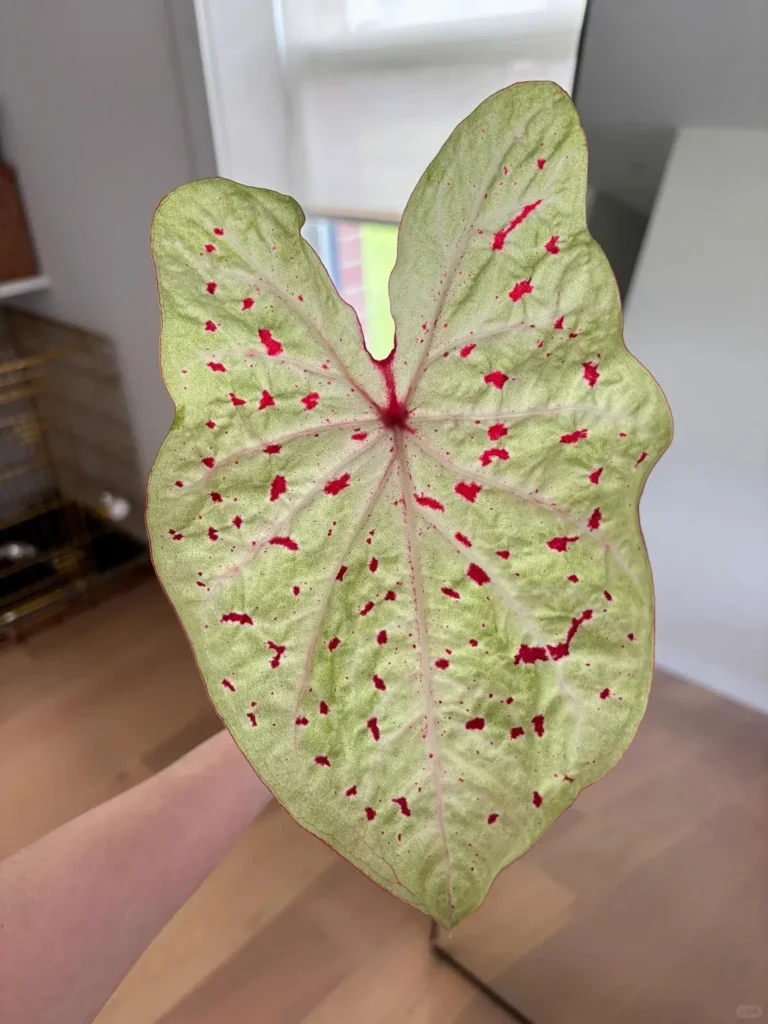
That leaf was striking. The base was a soft lime green, almost glowing, with clearly defined burgundy speckles scattered across the surface. The contrast felt delicate but intentional. The veins were visible. The structure was compact.
My first impression was simple: this variety was exactly what the photos promised.
But that impression didn’t last long.
After moving it to my north-facing balcony, where light was noticeably weaker, the plant began to change. The green deepened. The contrast softened. The speckles became less defined. Over time, the leaf lost much of its luminous quality and shifted toward a uniform green.
Growth slowed significantly. Through winter, it barely moved. It didn’t produce a strong dormancy cycle with obvious tuber swelling, but it also didn’t actively grow. It simply sat there — stable, but unimpressive.
At that point, I assumed it was a light issue — and later I realized Miss Muffet reacts to indoor and balcony light much more sharply than most caladiums.
2024 – South Balcony, Stronger Light
In 2024, I relocated the plant to my south-facing balcony.
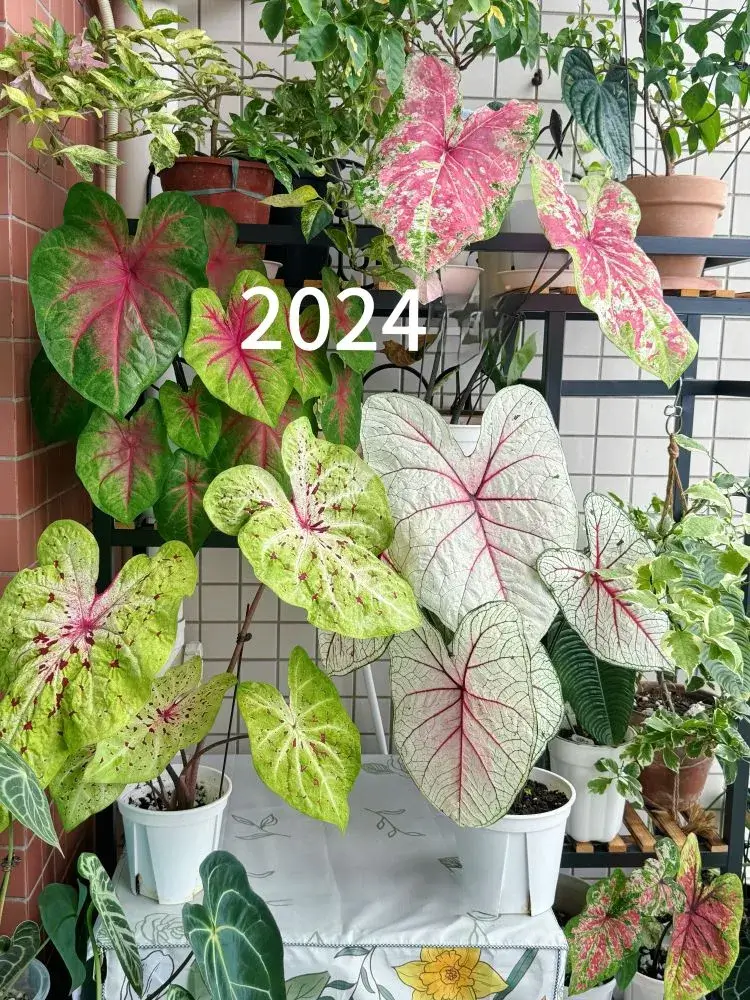
Light levels increased dramatically. The difference was immediate.
Leaf size expanded. The plant looked healthier, stronger, and more established. However, something unexpected happened: while the leaves grew larger, the number of leaves remained relatively limited. It wasn’t producing a dense canopy — just fewer, bigger leaves.
Color partially improved. The lime tone returned slightly, and the speckles became more visible again. But the stability wasn’t consistent. Some leaves looked closer to the original photos; others leaned greener.
It was better — but not fully restored.
That was when I started questioning whether light alone explained everything.
2025 – Repotting and Fertilizer Boost
In 2025, I made two significant changes.
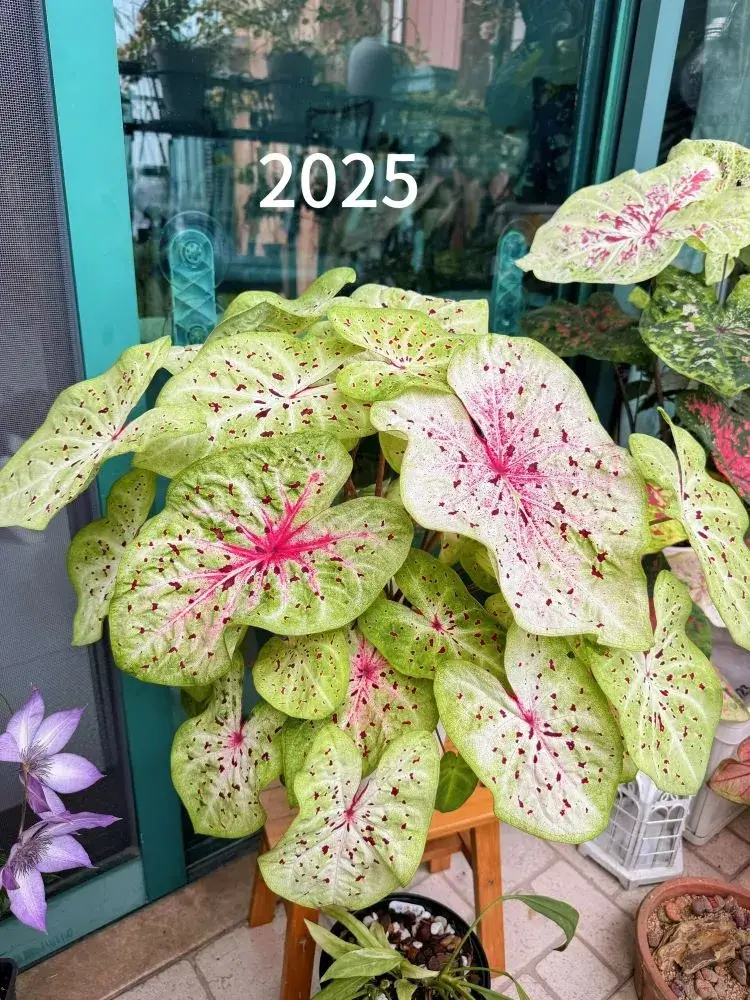
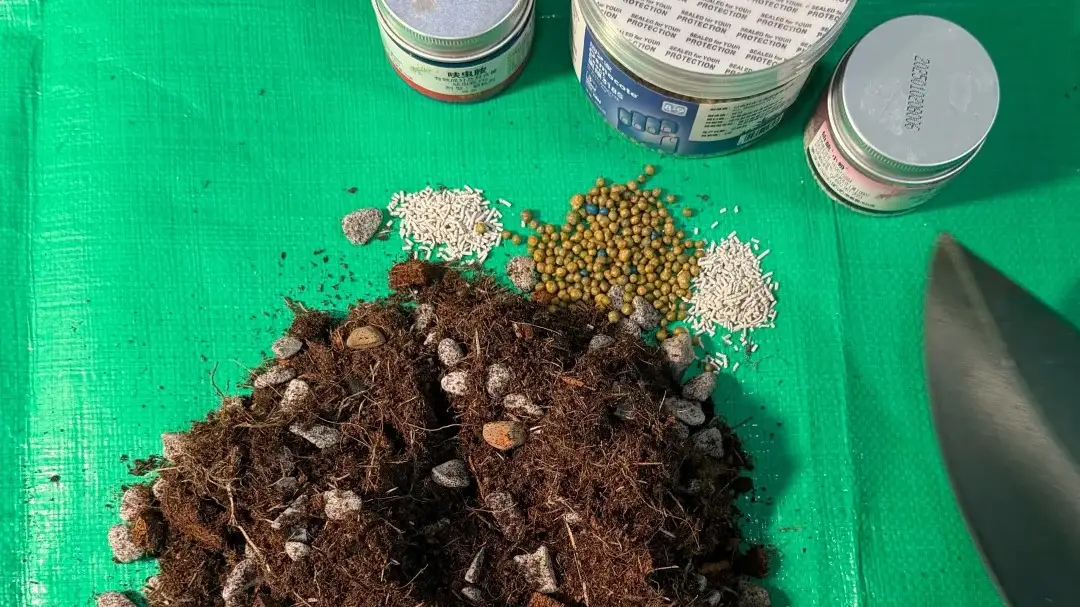
First, I repotted it into a 16 cm container, giving the root system more space — and that alone changed how fast it could push new leaves.
Second, I began feeding it more consistently, including occasional monopotassium phosphate applications and diluted leftover fertilizer from other plants.
The response was dramatic.
Growth accelerated. Leaf production increased noticeably. The plant no longer seemed hesitant — it pushed foliage with real energy. Compared to the previous two seasons, this was its most vigorous year.
However, even during this explosive growth phase, color variability remained. Some leaves expressed lighter tones; others shifted quickly toward deep green, especially during hotter periods.
By this point, I realized something important:
Miss Muffet’s behavior couldn’t be explained by a single factor. Light mattered. Pot size mattered. Fertilizer mattered. But even with all variables optimized, color expression still fluctuated.
Three years.
Same plant.
Three very different outcomes.
And that’s when I began thinking about genetics rather than just environment.
Light Is Everything (And Heat Changes the Story)
If there is one variable that consistently affected Miss Muffet’s appearance, it was light.
This variety cannot sit in average indoor brightness and expect to maintain contrast. In my experience, it needs to be placed in the brightest possible position — ideally where light intensity reaches or exceeds 10,000 lux during the day. Anything significantly lower, and the color shift begins quickly.
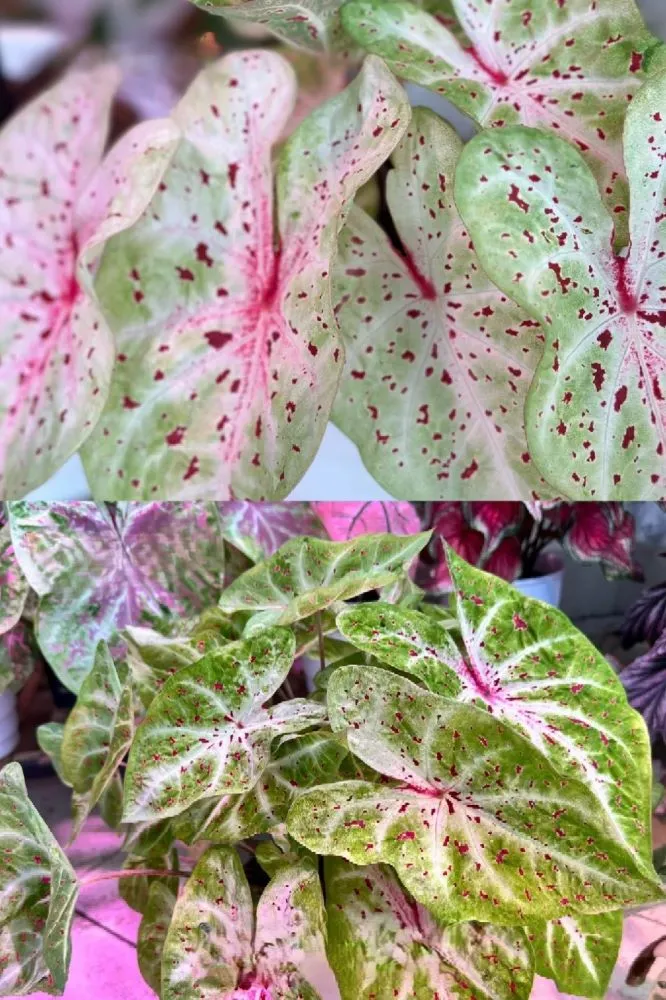
Under insufficient light, the lime tone deepens. The burgundy speckles fade. The leaf gradually transitions toward a uniform green. The process isn’t subtle — it happens within a single growth cycle. New leaves emerge greener, and existing leaves slowly lose their contrast.
Moving the plant from my north-facing balcony to a south-facing position dramatically improved leaf size and partial color expression. That alone confirmed how light-dependent this cultivar is.
However, strong light does not guarantee stable color.
Heat changes the story.
During high summer temperatures, I observed something different: even in bright conditions, the plant shifted toward a deeper green. It wasn’t just new growth. Mature leaves also lost contrast and became noticeably greener. If you’re also seeing yellowing at the same time, it helps to separate seasonal leaf turnover from true decline. The transformation could happen within days of a heat wave.
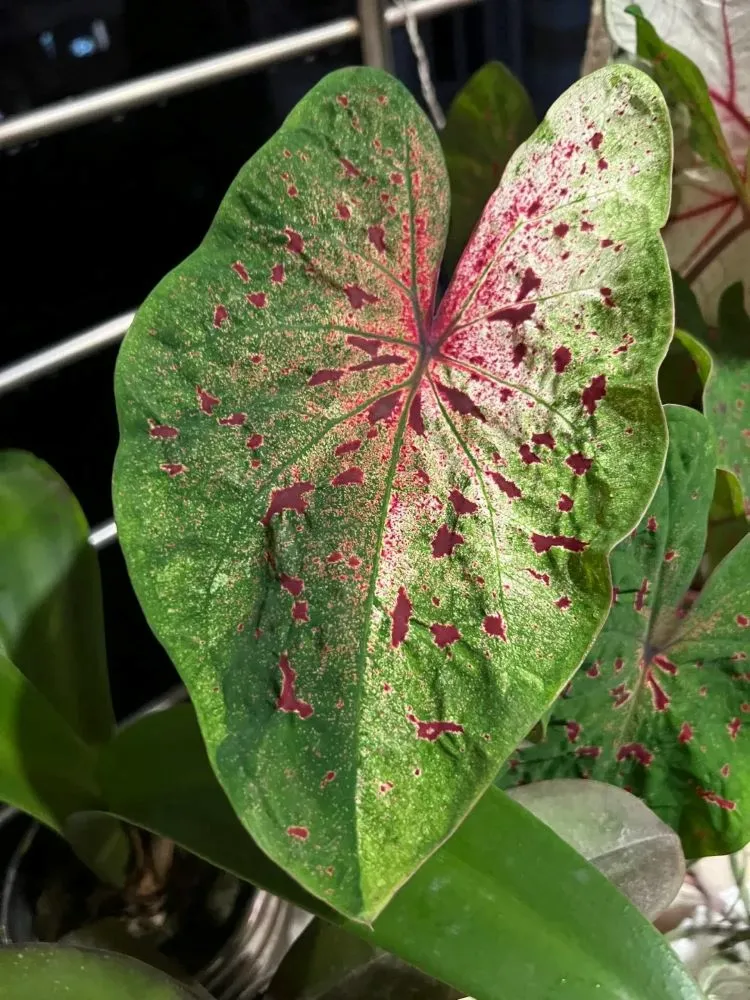
This suggests that Miss Muffet is not only light-sensitive, but also heat-sensitive.
In very warm climates, maintaining that soft lime-green appearance may be difficult, even with adequate light. In slightly cooler regions, the contrast appears more stable.
In short:
- Bright light is non-negotiable.
- Low light results in rapid greening.
- High heat can override good light and trigger full green mode.
- Older leaves can also revert.
For this cultivar, environment is not just a background condition.
It actively determines how the plant expresses itself.
The Genetic Question – Why Miss Muffet Is So Unpredictable
After adjusting light, changing placement, increasing pot size, and refining fertilizer rhythm, one pattern still remained: color stability was inconsistent.
At that point, I stopped assuming the issue was purely environmental.
The “Deep Green Gene” Reality
By the second and third year, it became clear that this was not just a first-year adjustment issue.
Even under strong light and improved growing conditions, Miss Muffet still leaned heavily toward green during certain periods. The shift was not subtle. Leaves that began with decent contrast would gradually deepen into a more uniform green tone.
If environmental correction does not fully restore color, genetics must be part of the equation.
Some cultivars have strong variegation stability. Others express their lighter tones only within a narrow environmental window. Based on three seasons of observation, Miss Muffet appears to sit closer to the latter.
The lime-green, speckled look seen in promotional photos may represent an optimal expression — not the default baseline.
In my experience, deep green is not an accident. It is a recurring tendency.
That realization changed my expectations. Instead of chasing perfect color, I began observing patterns.
That One Half-Light Leaf
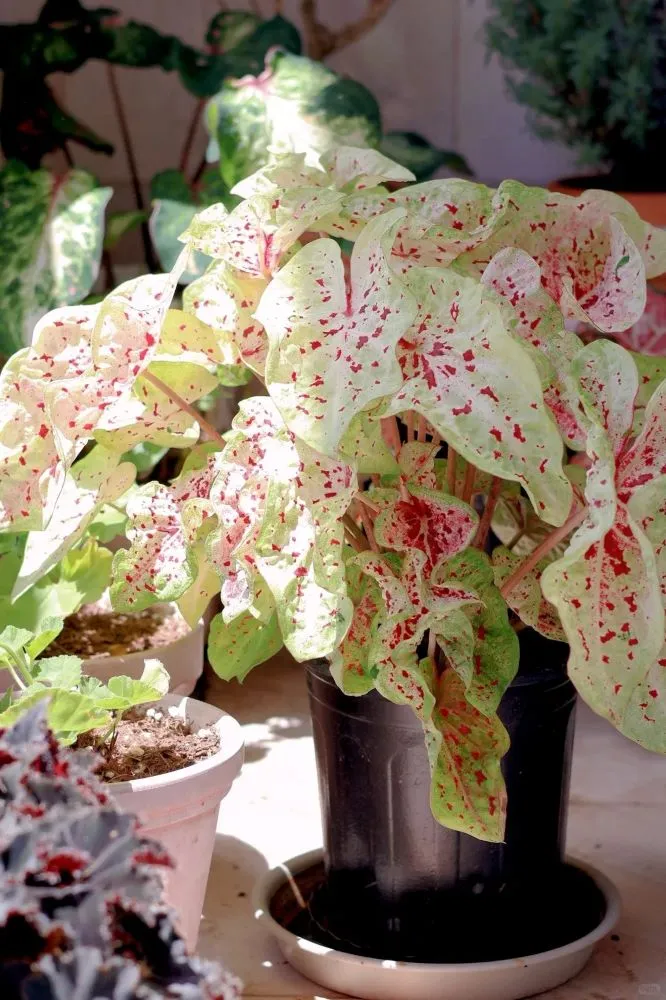
And yet, the story isn’t completely fixed.
After months of predominantly green growth, a new leaf emerged with one side noticeably lighter — closer to that soft, glowing lime tone I remembered from the beginning.
It wasn’t fully restored. It wasn’t dramatic. But it was different.
That single leaf suggested something important:
The lighter expression isn’t gone — it’s conditional.
Miss Muffet does not behave like a stable white-variegated plant with predictable contrast. Instead, its expression seems responsive and somewhat stochastic. Temperature shifts, subtle light differences, or internal growth cycles may influence pigment distribution in ways that aren’t entirely controllable.
The genetics allow for brightness — but they don’t guarantee it.
That unpredictability can be frustrating if you expect consistency. But it can also be intriguing if you view the plant as dynamic rather than fixed.
After three years, I don’t consider Miss Muffet unstable in a negative sense.
I consider it environmentally sensitive — with a genetic ceiling that defines how far color contrast can realistically go.
My Honest Conclusion After Three Years
After three full seasons of growing Miss Muffet, my expectations have changed.
It is not a consistently fluorescent lime-green variety. That bright, glowing look is possible — but not guaranteed. In my experience, the plant is extremely sensitive to light intensity and temperature shifts. Even small environmental changes can push it toward deep green.
More importantly, I’ve come to believe that genetics set a ceiling on how stable that contrast can be. Environment can optimize expression, but it cannot fully override the plant’s inherent tendencies.
And yet — when conditions align just right — Miss Muffet can still surprise you. A balanced season with strong light and moderate heat brings back that soft lime tone and defined speckling that made me buy it in the first place.
It’s not a predictable variety.
But when it performs, it’s genuinely striking.
FAQ
If your plant is placed in bright conditions but still turning green during heat waves, temperature may be the dominant factor rather than light alone.
That said, direct harsh midday sun can cause stress in very hot climates. Bright, stable light without extreme heat seems to produce the best color balance.
I’ve observed occasional lighter leaves emerging after a period of deep green growth. However, the plant does not reliably “reset” back to full brightness. Environmental improvements may help, but genetics appear to influence how stable the lighter tone can be.
If the plant has turned fully green, recovery is possible but not guaranteed.
Over three seasons, I’ve seen consistent greening patterns that suggest genetics set boundaries on how far the contrast can go. Some plants express brighter lime tones only under very specific conditions.
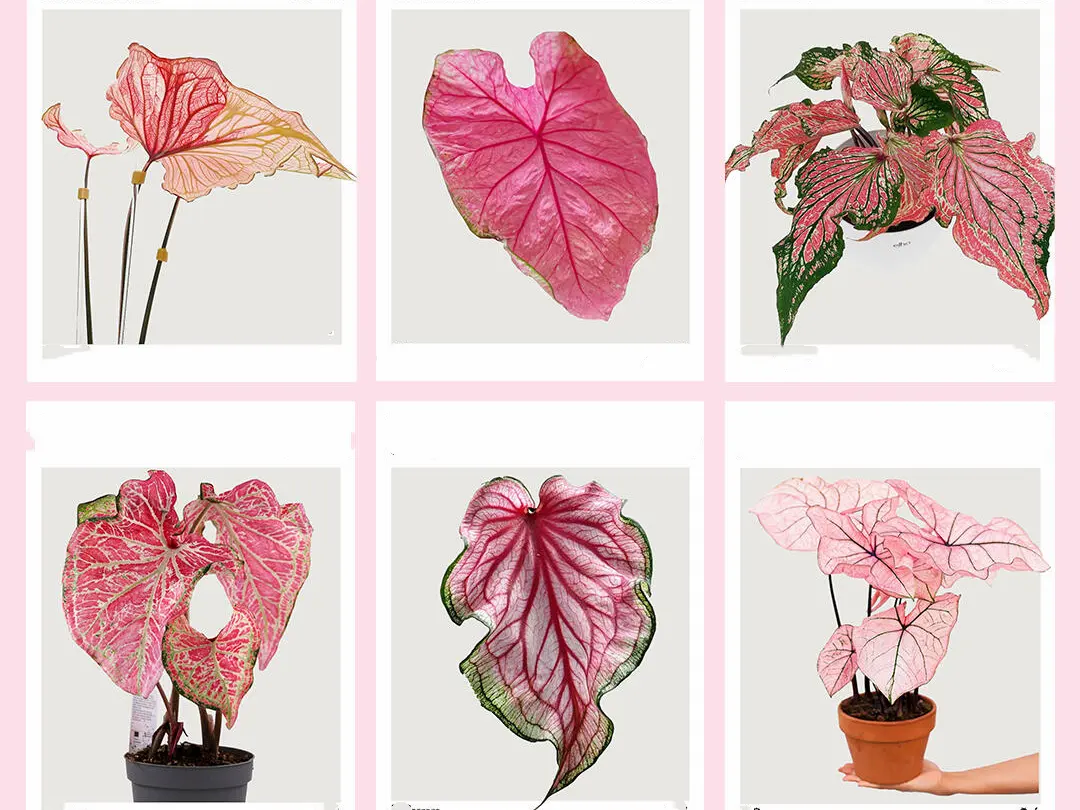
It’s less predictable than many pink-centered caladium varieties.
This is important because it means greening isn’t always a sign of nutrient deficiency. It can simply be a seasonal heat response.
If you live in a bright but not excessively hot climate, it can be manageable and visually rewarding. However, in very warm regions or low-light apartments, maintaining the classic lime-speckled look may be frustrating.
It’s not difficult to grow — but it is demanding in terms of placement.
Want to Explore Other Caladium Varieties?
Understanding caladiums starts with seeing how each variety behaves.
Browse All Caladium Varieties →